Prices

I usually give some idea of the cost of the book from a single supplier. There is no particular significance to this, the chosen source simply being the cheapest I could find with minimum searching of the interweb on the date of the original posting.
Showing posts with label Home brewing. Show all posts

Tuesday, 10 July 2012

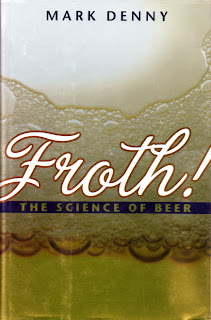
Froth! 

The Science of Beer

Mark Denny
2009, HB, 183pp
The Johns Hopkins University Press
£13.50 delivered from Amazon
Reviewed July 2012


Mark Denny is a homebrewer and a physicist. In the Introduction he sets out his stall: “My book is unique to the best of my knowledge, in that it unites brewing with accessible physics.” I imagine that at this point many of you will move along but I rather like the idea. After all pretty much everything is physics, even beer. But if mixing physics with beer isn't for you then it gets worsethere's mathematics too. (I'm not selling this well, am I?). But panic not, the maths can be bypassed—that's what I did most of the time.

Before getting to the science Denny outlines the history of beer and brewing. Maybe he should have stuck to the science. This chapter is riddled with inaccuracies and not-quite-accurate assertions. Did Balling introduce the hydrometer into brewing in 1843? That must have surprised Baverstock you was using one in 1770. Is porter really stronger than stout? Is stout usually dry? Guinness has been so only since the 1950s and London stouts never really were. This chapter is too long and a rather out of place. This is a book about “the science of beer”—get to the science! And I hated the stupid interlude inserted to break the chapter into two.

Next up is How to Make Good Beer at Home. Still no science then. This is a very basic introduction to homebrewing but at the same time idiosyncratic and opinionated. Certainly not for the homebrewing purists. Denny advocates natural cooling of wort, plastic bottles etc. Personally I don't have too much of a problem with that but like the previous chapter this seem a bit out of place in a book about the science of beer. Who is the book aimed at? The general reader? The beginner? Or the more advanced brewer? I would have thought it was the latter in which case a homebrewing primer is an unnecessary waste of space.

There are some odd mistakes for a scientist to make like stating that crystal malt is an adjunct: the clue is in the name, surely—it's a malt. And using the yeast from bottle conditioned beer: ”Don't throw away the gunk—feed it with yeast nutrient...and pitch it into your next brew. It will go like a rocket.” Probably not.

Finally, nearly halfway through the book we get to the science. The book gets much better from here.

Yeast Population Dynamics
Quite a lots of mathematical formulae from here on but these are explained and can be skimmed over and the text will still make sense.

This chapter contains one of the best description I have read of why yeast pitching rate is important. Clear, concise, and well explained both mathematically (by formulae) and in the text. The maths can be hard and is mostly beyond me but the explanations are good.

Brewing Thermodynamics
Sounds a laugh-a-minute, doesn't it?. But, of course, temperature control is a fundamentally important part of brewing so this is relevant stuff. The chapter covers a whole range of situations such as the heat produced by yeast during respiration, heating the mash, cooling the wort, temperature control etc. Lots of good stuff.

Now it has to be said that the design of the formulae and the associated explanations is a bit poor. New terms are introduced and the explanation of what they represent can be hard to find, sometimes hidden in the text of the next paragraph. Poor book design, in fact.

One thought provoking fact: enough heat is produced by the fermenting yeast in a standard wort to boil the whole batch. Lucky that heat is lost from the fermenter then.

Bubbles
Bubbles are everywhere in brewing. You might have noticed that. I found this chapter really stimulating. They is quite a lot of abstruse science, and I am sure some of it isn't that important, but most of it was absolutely fascinating. Fermentation is discussed in some detail and we learn that a typical homebrew fermentation might generate 35 billion bubbles. See what I mean? Not terribly useful but interesting and dead good for boring the guys down the pub. Denny points out that (for the US, I think) 0.5% of all carbon dioxide emissions are produced by beer production.

Beer froth and head production turn out to be more complex that you might think. Hey, one paper on the subject received an Ig Nobel Prize. The head on a beer is a surprisingly complex and dynamic system as Denny explains. He also discusses the background to the use of nitrogen/mixed gas and also shows why it isn't terribly beneficial to beer flavour. He gives a great explanation of how a widget works. They are surprisingly simple and are, in effect, a type of sparkler. Mention is made of disproportionation, which is another good one for use down the pub, and negative bubbles (a spherical layer of gas with liquid inside and outside of the sphere.

This chapter is probably the most successful of the book and is full of fascinating insight and some interesting science.

Fluid Flow
The final “science” chapter uses its title rather liberally. Most of it is taken up with the mathematics of bulk beer distribution which is, just about, an example of fluid flow. This is the only section where I found my inability to understand the mathematics frustrating. It would have been helpful to have had the various formulae more fully explained and not to have taken so much on faith. Maybe an appendix for thickos like me could have been added?

A brief discussion of how beer is moved from cellar to bar and an appreciation of how complex the action of drinking a beer is in terms of physiology, completes the chapter.

There are a few odd assertionsare electric pumps replacing beer engines on the bars of English pubs? I'm not sure when I last saw an electric pump. I used to love watching a diaphragm pump dispensing a pint of Bank's mild when I were a lad. But then earlier in the book there was the assertion that the barrel (36 gallon) and the pin (4½ gallon) are the most common UK cask container size when the firkin (9) and the kilderkin (18) are, by far, the most common size encountered.

Final Thoughts
Not a lot to say about this chapter. Simply a summing up of what went before.

Throughout the book some of the graphs are poorly designed and sometimes inappropriate for the data they depict—line graphs where bar graphs would have been better, for example, which is rather odd for a book published by an university press.

The very simple brewing technique described is at odds with some of the science explained, especially in the thermodynamics section.

The book is a good quality hardcover, nicely printed, with a sown binding. In fact the cover is so substantial, for the size of book, that it may constitute a dangerous item. Don't try and take it onto an airplane.

Froth! is a brave attempt at a different homebrewing book. It contains some thought provoking information and certainly encourages the reader to look at things from a different perspective. But it is not a great book. Nearly half the book is not, in fact about “the science of beer”. Most of the beery science is interesting, some of it thought provoking, and some of it might even improve your brewing. Although the text is designed so that the mathematics can be missed out it is a pity that some space could not have been found to more fully explain how the formulae are derived. The mathematics is the backbone of several sections and not being able to understand it is very frustrating.

Froth! is not a book for everyone and newby brewers should avoid it if they don't want their head to explode. The more advanced and/or technical brewer will certainly get something from the book and it encourages the assessment of the brewing process from a new perspective.

So recommended (but with significant reservations) especially at £13.50 for a “proper” hardback.

Sunday, 22 May 2011

Brewing
Michael J Lewis & Tom W Young
1995, PB, 260pp
Chapman & Hall

£43.34 delivered from Amazon

Reviewed May 2011


This is a review of the first edition of this book. The second edition (larger at 408pp) is currently available but I don't have that in my library. Yet.

I am what you might call a technical home brewer. I don't brew in pots and pans in the kitchen but have a permanent brewery and temperature controlled fermenters permanently set up in the garage, for instance. And I love the science stuff. I am also from the UK and most of the beers I brew are British in style. Trust me this is relevant to the review.

There are a lot of home brewing books out there including any number of basic how-to-brew titles and a smaller number of more advanced guides. These vary in quality from the outstanding to total rubbish. There are also a surprising number of professional brewing text books. Most of these are of limited use to home brewers or microbrewers because they deal with modern industrial brewing using techniques and methods out of our price or technological range. A smaller number do have useful information, at least in part. The greater proportion of English language brewer's books of both persuasions are US in origin and brew with a US attitude.

“Brewing” doesn't fit into any of these groups. Michael Lewis is based in California and Tom Young in Birmingham, UK. Lewis gained his PhD Birmingham University in the UK, however. The book seems to be aimed at small scale commercial brewers and has a distinctly British attitude to brewing, and this is reinforced by the use of litres, celsius and kilograms alone in the body of the text. This is a pretty unusual combination and makes it a valuable book in itself, especially to us Brits.

Now lets be clear: this in not a let's-start-brewing book. It assumes a level of technical and, especially scientific, knowledge. If you didn't study science to advanced school or, better, college level you are going to struggle. That's not a criticism of the book, just a reflection of who it is aimed at. As a random example you need to comfortable with stuff like this: “Carboxypeptidases survive kilning but endo-ß-glucanases are much more heat labile. There is a danger therefore that if ß-glucanolysis is incomplete in malting, ß-glucans could dissolve in mashing under the influence of a carboxypeptidase (called solubilase) with insufficient endo-ß-glucanase to reduce its viscosity.” See what I mean?

To be fair, the authors say in the preface, “it is our intention and our hope that this book will provide a useful and practical grounding in the fundamentals of brewing science and the practice of brewing.” It is significant that they put science before practice because that is the way the book is arranged.

The book is logically organised and follows the brewing process from beginning to end. After a simple Overview of the Brewing Process in proceeds to Basic Chemistry for Brewing Science. In many ways this is the most important chapter in the book and its 28 pages need careful reading. Although the chapter starts with the basics of water chemistry within the first paragraph it is clear that the authors concept of basic assumes the reader understands terms such as “element”, “valence”, and “Lewis structure”. If you don't it would be best to put the book down and get hold of a science primer because without some underpinning knowledge this chapter and most of the rest of the book is going to be meaningless.

If you pass the Basic Chemistry Test the rest of the book lies before you. All the usual stages are covered from a scientific point of view although at the same time the focus is on small-scale, low technology brewing. For instance the chapter on Mashing Technology devotes most of its description of the mashing process to simple infusion mashing although temperature-controlled mashing, decoction mashing, double mashing, lauters and mash filters are covered. The authors make the point that “infusion mashing is particularly attractive in small breweries because the vessels are simple and cheap, and easily scaled to their low output.”

The rest of the process is examined in similar vein. There are a large number of line drawings, graphs, tables, and chemical pathways illustrated throughout the book including such delights as the Embden-Meyerhof-Parnas pathway, the Burton union sytem of traditional fermenters, the design of a “python”, and the function of a beer engine. Sadly the authors couldn't resist the temptation to include that really dodgy tongue map of flavour sensing areas. Mind you the accompanying text is a lot better.

I particularly like the chapters of yeast and fermentation. This, of course, covers the biochemistry of the process in some detail, as you would expect. Yeast culturing and propagation is considered. The delights of long term yeast storage are discussed (clearly beyond most home brewers or microbrewers) but this is balanced out with much more practical discussions of cropping yeast for re-use and the use of dried yeast (even though there will be those rolling there eyes at the very thought). Although not a laboratory manual simple laboratory methods of practical application are discussed such as storage yeast on agar and yeast viability counts using a light microscope and haematocytometer.

Brewing” balances on a wire between a scientific treatise on the brewing process and a practical how-to-do-it manual. It pulls this off very well. If is a, relatively small, guide to the brewing process which contains most of the information a home- or microbrewer will ever need. It certainly deserves a place on the bookshelf of any brewer who has the scientific background to digest it. Recommended.

Who should buy “Brewing”?
Starting out home brewer: step away from the book.
Advanced home brewer: yes, if you have the science.
Microbrewer: why haven't you got it already?

Friday, 30 July 2010

Brewing With Wheat
The "Wit" and "Weizen" of world beer styles
Stan Hieronymus
Brewer's Publications 2010, PB, 216pp, 8 colour plates

£8.07 delivered from Amazon

Reviewed July 2010


I liked Stan's previous book "Brew Like a Monk", as you can see in my review on this blog, & I was pleased when I found out he was working on a book about wheat beers, a variety of beer I enjoy but don't know too much about.

BWW is similar in format to BLAM. It is not a "how to brew a wheat beer" guide and, although there are details of many beers discussed there are no recipes as such. I think this is one of the strengths of the book. Enough detail of the production of, and philosophy behind, named beers is given to inspire a brewer in recipe formulation with out getting bogged down with details of the brewing process that any reader is going to understand anyway.

The book starts by discussing wheat as an ingredient, both in bread and beer, from an historical perspective. Wheat has always been important in baking and has become increasingly so over the last two centuries whereas, on the other hand, wheat was in the past much more important in brewing than it currently is, although it is being more widely used these days.

A characteristic of most wheat beers is haziness and cloudiness. A very interesting chapter is devoted to this. A beer made from 20% wheat would probably have some haze but, as the proportion of wheat is increased the degree of haze will decrease. Yes you read that right. A 50-60% wheat beer will probably drop bright. Now, of course, this is the sort of proportion used in, say, a German hefeweizen which would not be bright. The brewers of hefeweizen overcome this inconvenient clarity in a number of ways such as removing the primary yeast, flash pasteurising to stabilise the protein in suspension, and then bottling with a non-flocculant yeast to prevent it settling and dragging down the protein with it. Draft hefeweizen containers are delivered upside down so that the yeast and protein is resuspended before dispense. Although that seems a lot of trouble, it must be better than the strategy adopted by some US brewers of using additives such as Tanal A or Biocloud, which sounds yummy.

The same chapter includes a section on the production of the clove flavour found in weizen and wit beers. The flavour compound is 4-vinyl guaiacol (how the hell do you pronounce that!). Wheat contains the precursor of this in the form of ferulic acid. Ferulic acid is released from barley at a mash temp of around 45 °C and a temperature step or decoction mash may include a ferulic acid rest. Once the ferulic acid is released from the wheat it can be converted to 4-vinyl guaiacol by a suitable (Phenolic Off-flavour Positive) yeast. POF+ yeasts are characteristic of weizen production, less so for wit beers.

We then move onto a description of wheat beer by region: Belgium, Germany, and the USA. For many Hoegaarden is the definitive Belgian wheat beer but, as Hieronymous points out, Wit beer as a species had died out before Pierre Celis revived it in Hoegaarden and compared with historical examples it is atypical. In 1948 the great brewing scientist Jean De Clerk found that Hoegaarden, Peeterman, and Leuven Wit were all infected with Lactobacilli and sometimes Pediococci. He described Hoegaarden as very sour. It is not surprising that these beers were infected in this way because the brewers used white "wind" malt, short boil times (and may not have boiled the wort at all, merely heating it near to boiling), and very low hopping rates. The beers were cloudy and white from microbiological and protein haze and because the beers were drunk while still fermenting. Plenty of detail of old production methods for many types of wheat beer is given illustrating many various unique or just plain weird production methods.

A whole chapter is devoted, quite properly, to Pierre Celis who has had a role in the popularisation of spiced wheat beers, in the Belgian style, both in his home country but also the USA. Without Celis wheat beers, in particular Wit, would be no where near as popular as they currently are. His influence in the US has been phenomenal and he provides a direct link between Belgium and the USA. Mind you this chapter includes a section on Coor's Blue Moon. I recently had the misfortune to try this. It is a peculiar looking beer with an odd orange hue and a weird haze which doesn't look quite right. I wonder if this is Biocloud in action? Things got worse on tasting it. It is without doubt one of the most horrid beers I have sampled in the last few years. Mind you it could be worse. The next chapter describes a wheat beer with bloody Cascade hops in it. Wrong, wrong, wrong.

Anyway back to the book. Off to Germany next, so put the spices away and forget about Pierre Celis. First off, Bavaria for Weizen. Unlike Belgium, and often the USA  the spiciness evident in these beers  comes from the distinctive POF+ yeast. One of the great Bavarian Weizens is Schneider. This is produced  using an odd mix of techniques: a decoction mash (with ferulic acid rest) followed by top fermentation in open fermenters. The brewery believe the open fermenters, and the aeration they lead to, are essential in developing the clove-like flavours they want in their beers. Wheat beer nearly disappeared in Germany as it did in Belgian. It returned from the verge of oblivion when it became popular and trendy because of its perceived healthy appearance. Bless "the young", I knew they would be useful for something.

From Germany we move on to the USA. Wheat beer in all its varieties has been a big success in the USA. Some microbreweries find their cloudy wheat beers are their biggest sellers. It is hard to imagine that happening in the UK. I have to say I didn't enjoy this section, not that there is anything wrong with it. Its just that I get irritated with so many aspects of the US micro scene especially when they start messing around with things like Weizen which is just fine as it is. That's just me. A reactionary old fart.

Leaving the US behind we return to Europe for a discussion of various historical and less important wheat beer species. Things like Berliner Weisse (which is uncomfortably close to extinction), Gose, Lichtenhainer and the like. We are back to bacterial infections again.

The book concludes with a chapter on style guidelines and beer judging. The US style guidelines for some of these beers are, like several of the European styles, highly dodgy and apparently the standard of judging leaves something to be desired. I have little interest in style guidelines and not much more in judging but there is quite a lot of thought provoking stuff in this chapter and a lot of sensible advice on making  good wheat beer.

I didn't enjoy this book as much as BLAM but it does have plenty of interesting things to say. It is certainly worth the price and will be a useful book to have on the shelf for future reference. If you want to make a wheat beer it would be well worth reading BWW before starting.